
 Vikas Singh Gurjar
My experience was very good … very well taken care of .Thank u Dr Anjaly , Dr Vatsal, Deepak , Ganesh , Vishnu and Gopal for your services.
View on GoogleHome » Full Mouth Dental Implants in Indore

Care led by Dr. Ashish Jain
Precise, planned implant placement
3D scans under one roof
Digital, painless dentistry
At Smile Dental Clinic in Indore, full mouth implant rehabilitation is planned and performed under Dr. Ashish Jain, Managing Director, Dental Surgeon and Implantologist. This guide walks you through the whole subject – the different designs, the people it suits, the surgery, the months that follow and the questions of cost – so that you arrive at your consultation informed.
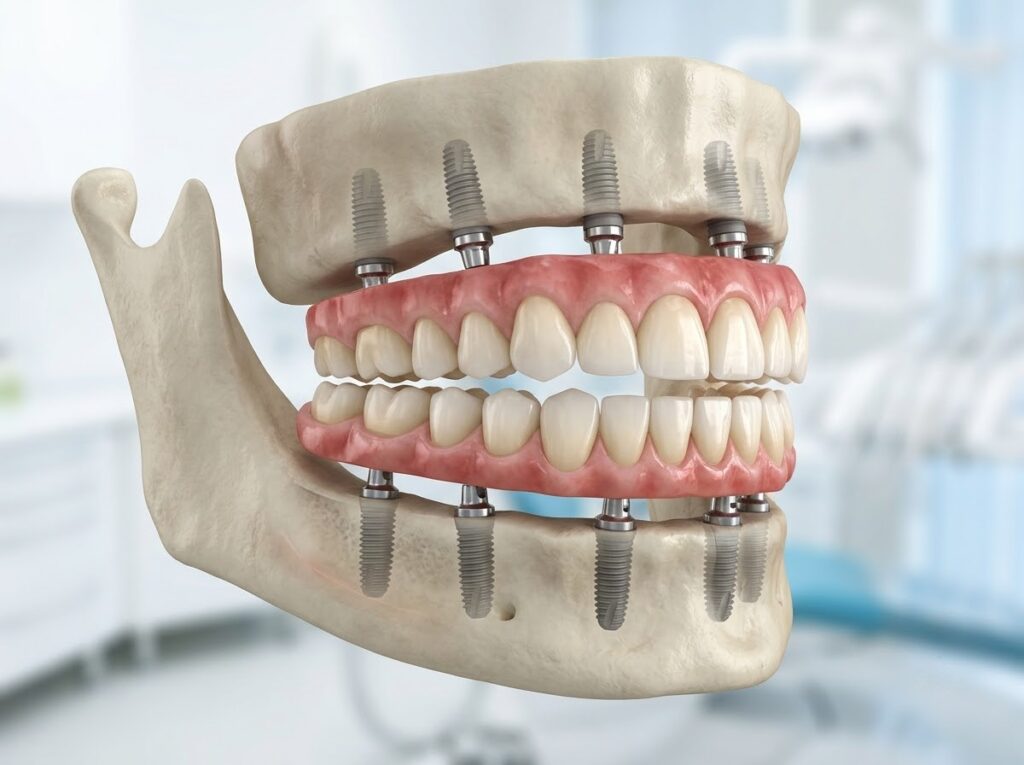
In brief: Full mouth dental implants replace all the teeth of the upper jaw, the lower jaw or both. A small number of implants per jaw – commonly four to eight – support a full arch of teeth. The teeth may be permanently fixed or, in some designs, removable by the patient. Which design is appropriate depends on bone volume, health, expectations and budget.
| Point | Summary |
|---|---|
| Purpose | To restore a complete arch (or both arches) of teeth on implants |
| Suitable for | People who have lost all teeth, wear loose complete dentures, or have teeth that are beyond saving |
| Implants per jaw | Often four to six for a one-piece fixed arch; six to eight when teeth are made in sections; decided after scans |
| Common designs | All-on-4, All-on-6, sectional fixed bridges, removable implant overdenture |
| Anaesthesia | Local anaesthesia, with or without sedation; general anaesthesia in selected cases |
| Temporary teeth | In suitable cases, fixed provisional teeth within a few days of surgery |
| Final teeth | Usually fitted after roughly three to six months of healing |
| Setting | Day-care procedure in most cases |
The dental term for having no teeth is edentulism. It may affect one jaw or both. Some people reach this stage gradually, losing teeth one by one over decades. Others arrive at it suddenly when advanced gum disease makes all the remaining teeth loose at the same time. There is also a third group, described by dentists as having a “terminal dentition”: teeth are still present, but so damaged by decay, infection or bone loss that keeping them is no longer realistic.
Complete tooth loss is more than a cosmetic matter. Without roots, the jawbone has nothing to hold on to and slowly melts away. Over years the lower third of the face shortens, the lips lose support and the chin moves closer to the nose. Complete dentures replace the visible teeth but not the roots, so this shrinkage continues beneath them – which is why a denture that fitted well five years ago often rocks and slips today.
Full mouth dental implants are a method of rebuilding an entire arch of teeth on implants. It is a common misunderstanding that each of the fourteen teeth in a jaw needs its own implant. That is neither necessary nor usual. A carefully positioned group of implants can share the load of a full arch, much as a few pillars carry a bridge deck.
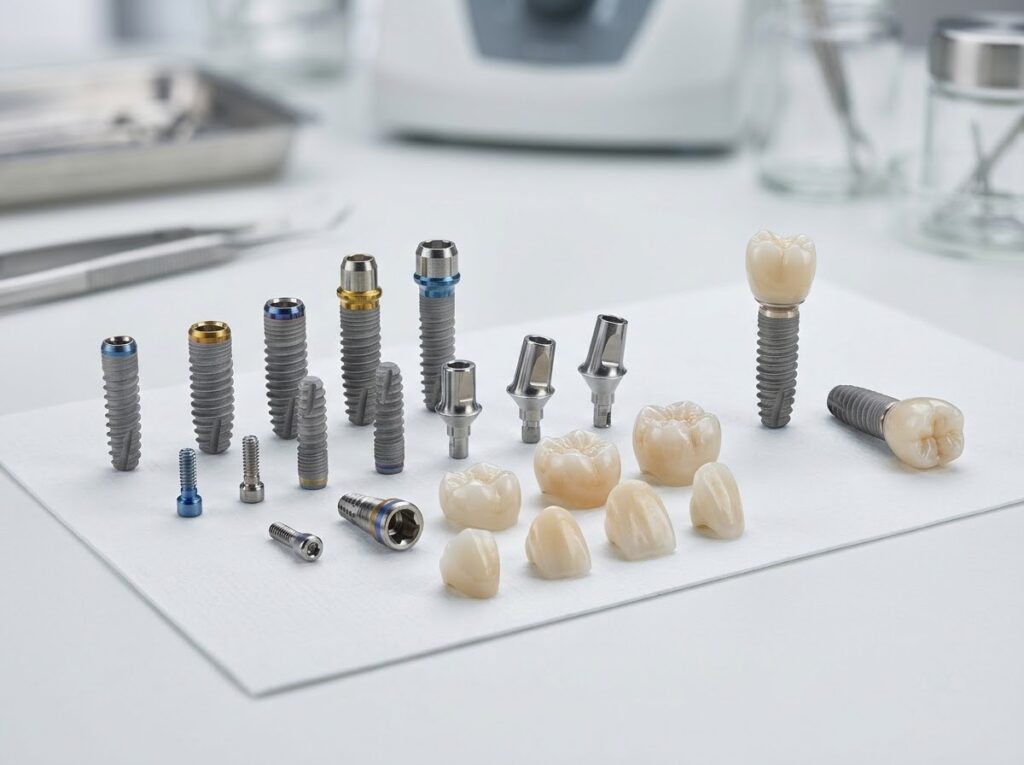
The treatment has two parts:
How the superstructure is attached, what it is made of and whether you can take it out yourself are the features that distinguish one design from another.
People who have worn complete dentures for years often accept limitations as normal. It is worth naming them, because they are the problems full mouth implants set out to address.
A conventional lower denture floats on a thin ridge and is moved by the tongue and cheeks. Biting into an apple, chewing nuts or eating fibrous vegetables can be difficult. Many denture wearers quietly shift towards softer, more refined foods, which may affect nutrition, particularly in older adults.
A loose plate can click or drop while talking. The fear of this happening in public makes some people avoid eating out or speaking at length.
Movement of the denture rubs the gum. Ulcers, the daily use of adhesive paste and repeated relining appointments are common complaints.
An upper complete denture covers the palate. Some wearers feel that food tastes dull or that hot and cold are harder to judge.
Each year the ridge becomes a little flatter, and the denture a little harder to keep in place.
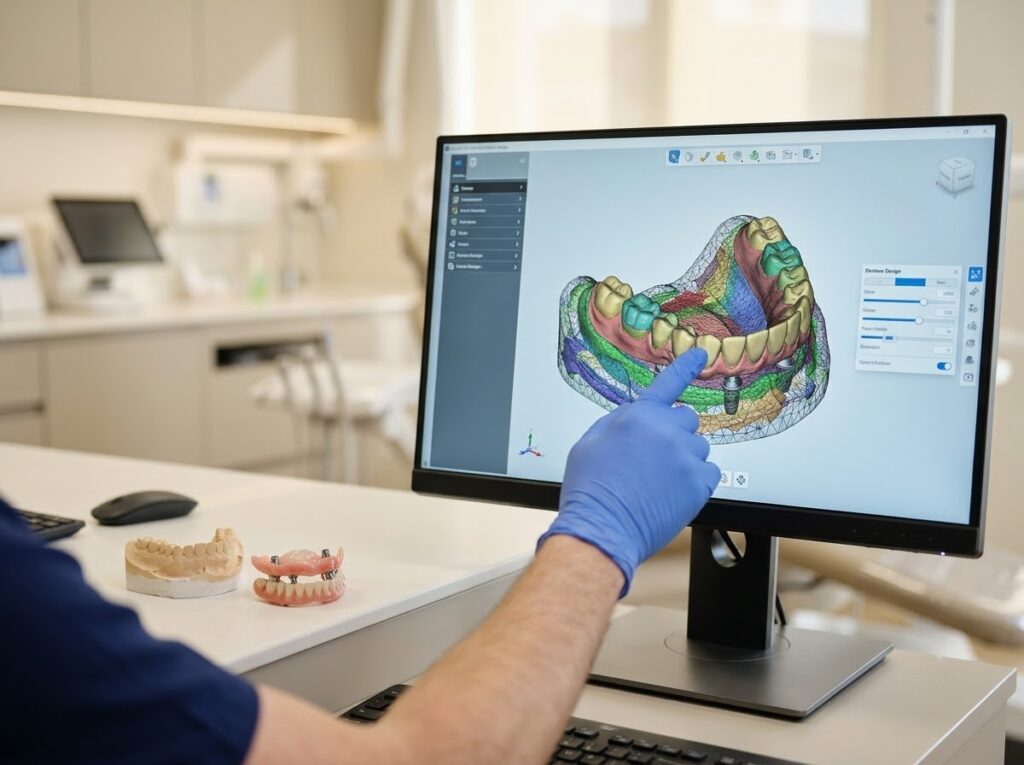
You may be a candidate for full-arch implant treatment if:
Being a candidate on paper is not the same as being suitable in practice; that is established by examination and scans.
There is no single “full mouth implant”. The main designs are outlined here so you can recognise the terms when they are used during your consultation.
| Design | Implants per Jaw (Typical) | Fixed or Removable | Suited To | Points to Weigh |
|---|---|---|---|---|
| All-on-4 | 4 | Fixed | Limited bone at the back; wish to avoid grafting | Less reserve if one implant fails |
| All-on-6 | 6 | Fixed | Adequate bone; heavier bite | Higher cost; more surgical sites |
| Sectional bridges | 6–8 | Fixed | Good bone; desire for most natural design | Most complex; may need grafting |
| Zygomatic | 2–4 long implants, sometimes with standard implants | Fixed | Severe upper jaw bone loss | Specialist procedure |
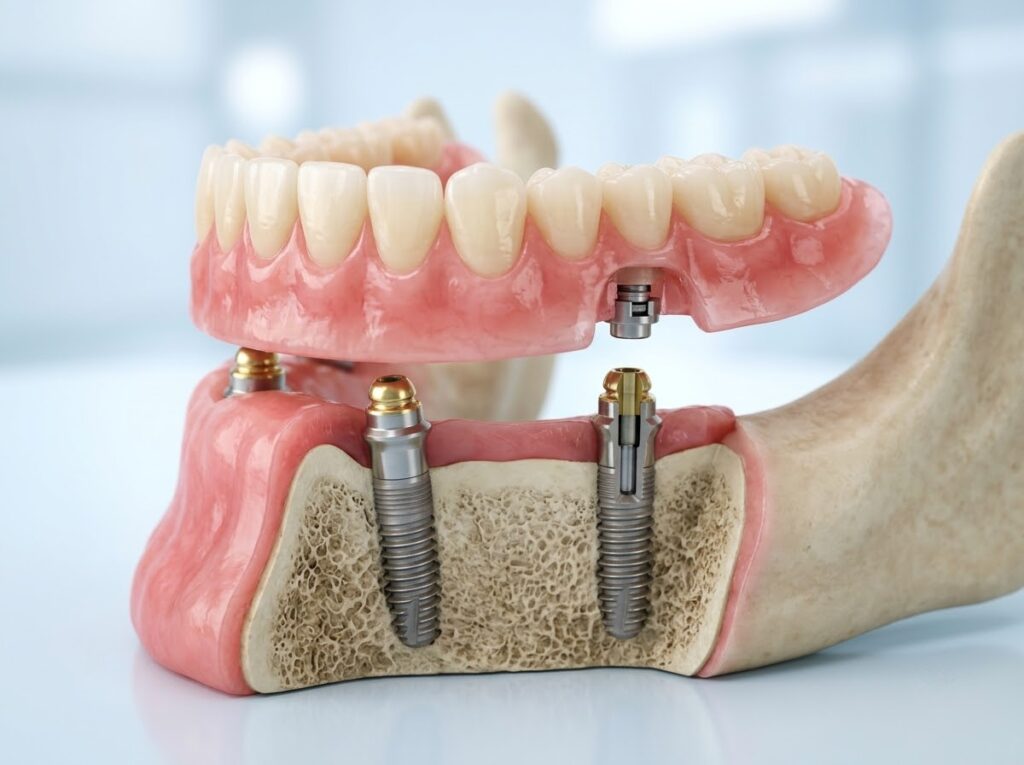
| Overdenture | 2–4 | Removable by patient | Budget constraints; easier cleaning | Attachments need periodic service |
Four implants support a full arch of fixed teeth. The two rear implants are usually tilted, which lets them engage stronger bone towards the front of the jaw and avoid the sinus in the upper jaw or the nerve in the lower jaw. This concept can reduce the need for grafting in people with limited bone at the back. With only four supports, however, each one is important; the loss of a single implant affects the whole arch.
Six implants carry the arch. The additional supports spread chewing forces more widely and provide some reserve. This design needs sufficient bone at six sites and involves a higher implant cost.
Rather than one continuous arch, the teeth are made as three or four separate bridges. This is closest to natural teeth in feel and makes future repair of one section easier. It requires good bone volume and is typically the most demanding option in terms of implants and laboratory work.
When the upper jaw has lost so much bone that standard implants cannot be anchored, very long implants fixed into the cheekbone may be considered. This is an advanced procedure undertaken only in selected cases and by suitably trained surgeons.
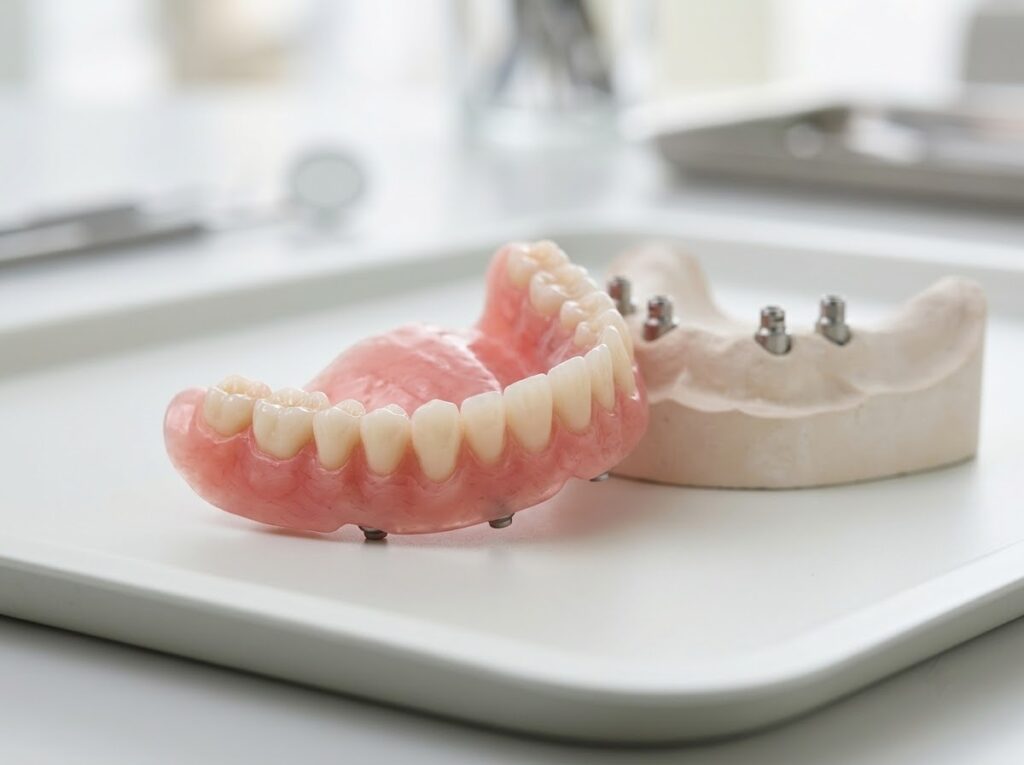
A complete denture clips on to two to four implants and is removed by the patient for cleaning. It is more stable than an ordinary denture and less costly than a fixed arch. This option is covered in detail on the implant-supported dentures page.
The teeth that are attached to the implants can be made in several ways, and the choice influences appearance, weight, durability and cost.
Your dentist will explain which materials are sensible for your bite, the space available between your jaws and what the opposing teeth are made of.
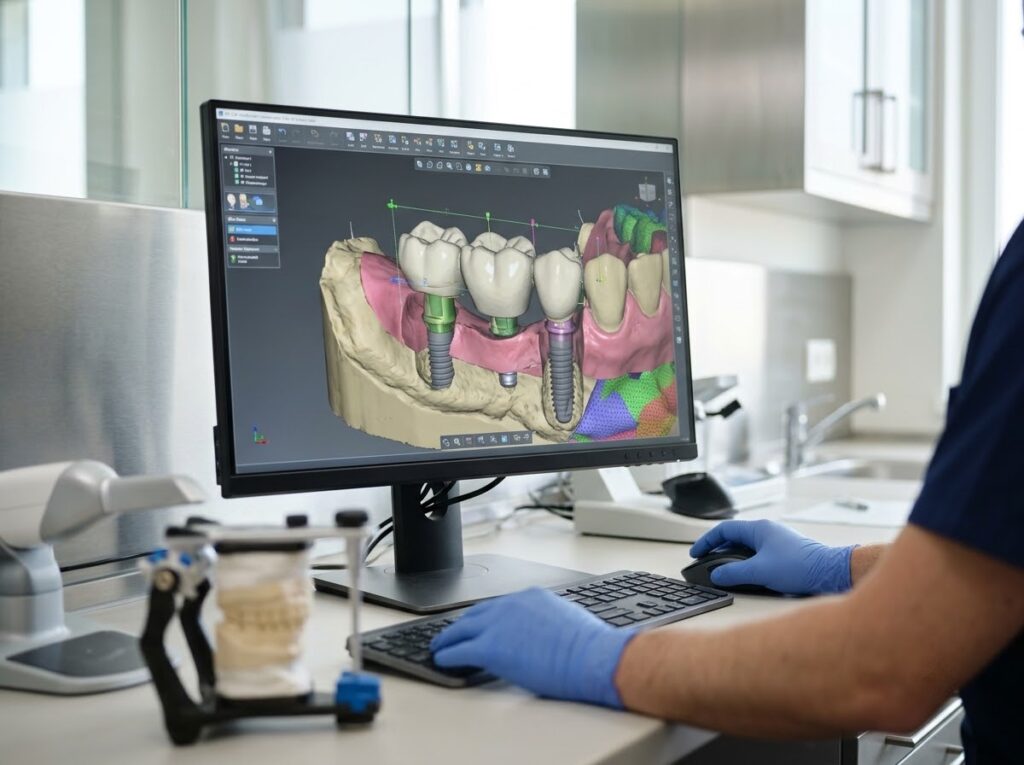
Full-arch treatment is planned backwards: the position of the final teeth is decided first, and the implants are then placed where they can best support those teeth.
Blood sugar, blood pressure, heart conditions, kidney function, bone medicines, blood thinners and smoking habits are all reviewed. For a longer surgery, your physician’s clearance and routine blood tests may be requested.
The dentist assesses the gums, any remaining teeth, the shape of the ridges, the smile line, lip support and the vertical distance between the jaws.
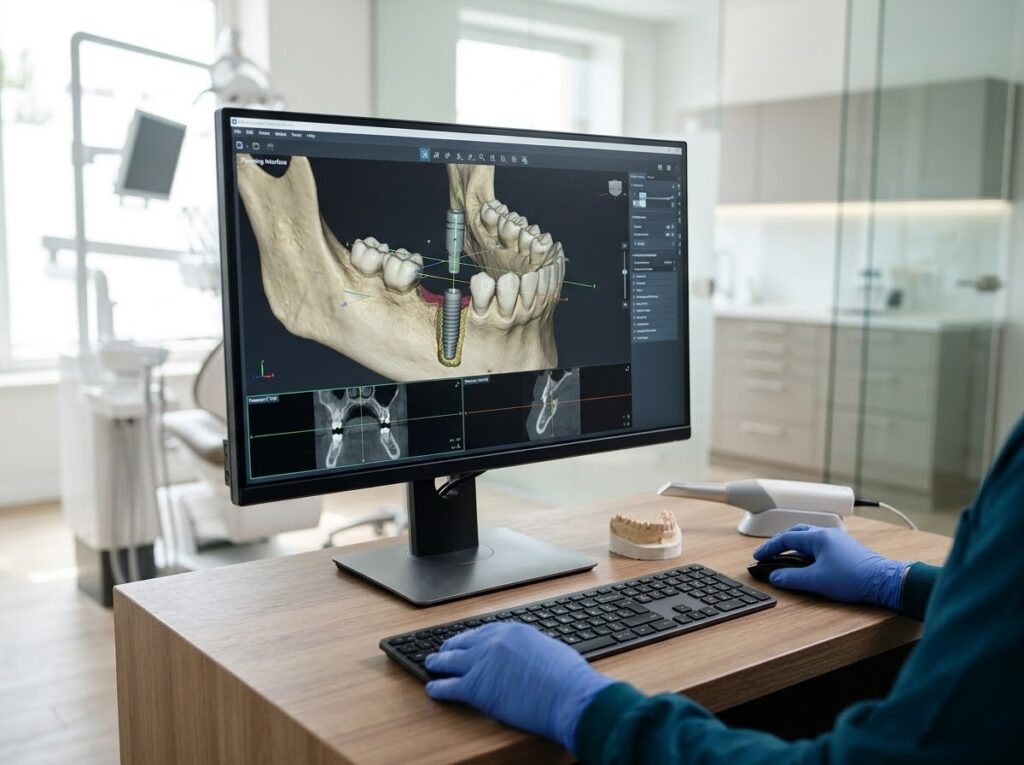
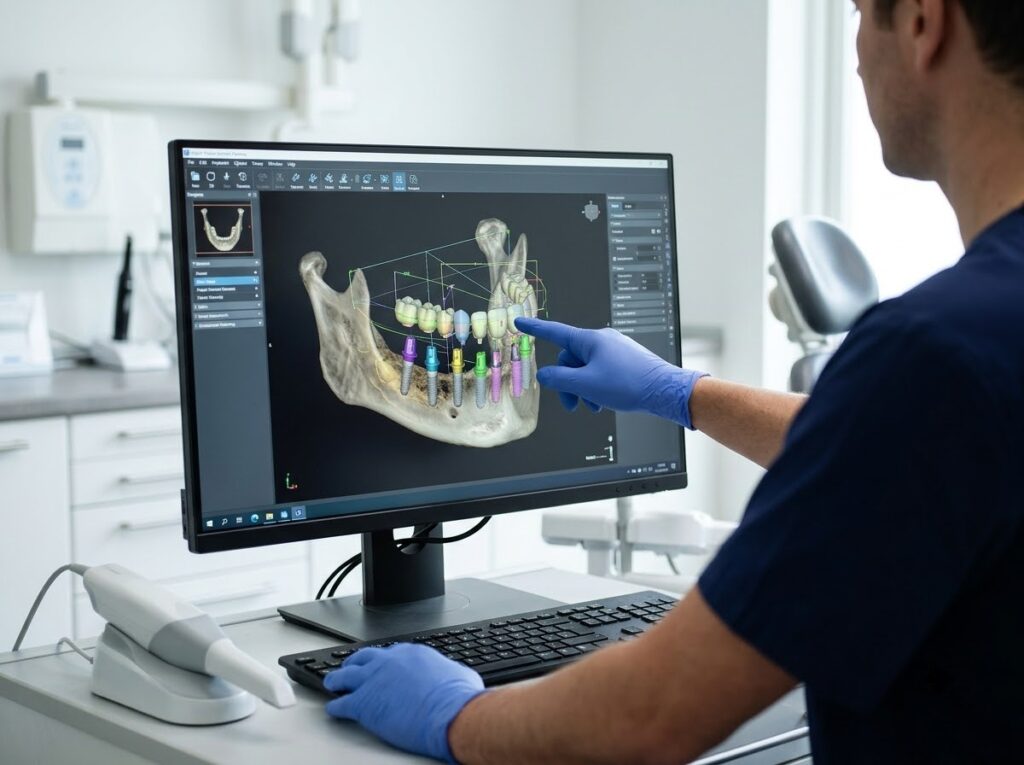
A CBCT scan maps bone height, width and density throughout the jaw and shows the sinuses and nerve canals. For full-arch work this scan is essential, not optional.
A wax or digital mock-up of the proposed teeth lets you and the dentist preview tooth length, lip fullness and bite before surgery. If you have a photograph of your smile from earlier years, bring it along.
Where some teeth are still present, a careful judgement is made about each one. Sound teeth are not removed without good reason. If enough healthy teeth remain to make a reliable partial plan, that alternative should be discussed with you.
Full-arch implants are usually advised when the remaining teeth cannot offer a predictable long-term foundation and the patient wants something more stable than a loose plate. Typical triggers include generalised advanced gum disease with mobile teeth, repeated failure of extensive dental work, intolerance of complete dentures, and severe ridge shrinkage that makes conventional dentures unstable.
Caution or postponement is appropriate in several circumstances:
In such cases, a well-made complete denture or a simpler implant overdenture may be the safer recommendation.
Teeth are removed, the jaw is allowed to heal, implants are placed and left undisturbed for several months, and the final teeth are fitted afterwards. A removable denture is worn in the meantime. This approach suits cases needing significant grafting or where bone is soft.
Teeth are extracted, implants are placed and a fixed provisional set of teeth is attached within roughly one to three days. This is the approach behind phrases such as “fixed teeth in three days”. It is possible only when the implants achieve firm initial grip in the bone at the time of placement; that is measured during surgery, so the final decision is sometimes made in the operating chair. The provisional teeth are for appearance and gentle function – they are replaced by the definitive set once the bone has bonded.
Using the CBCT data, implant positions are planned on a computer and transferred to the mouth with a printed guide. This can make surgery more precise and shorter.
Depending on bone shape, implants may be placed through small punch openings or by lifting the gum to see and reshape the ridge directly. Ridge levelling is frequently needed in full-arch cases to create a smooth platform and enough room for the prosthesis.
Every stage is planned around your scans, your bone and the final teeth you need.
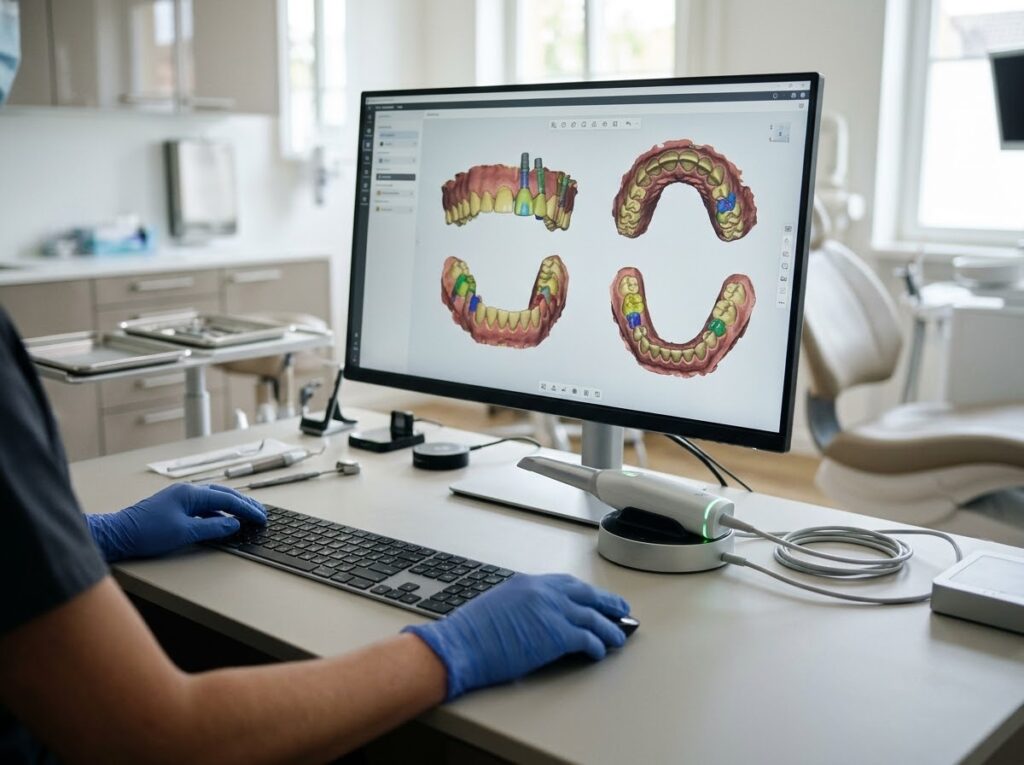
History, examination, CBCT, photographs, impressions or scans, and a discussion of options, timelines and estimate.
Medical clearance if required, control of blood sugar, cleaning of the mouth, and making of the provisional teeth or the template for them.
After anaesthesia, any remaining teeth are removed. Infected tissue is cleaned out and the ridge is shaped. Implants are placed at the planned sites and their stability is tested. Connectors called multi-unit abutments may be attached, and the gums are stitched.
If immediate loading is appropriate, records are taken and a fixed temporary arch is fitted within a few days. If not, a soft-lined removable denture is provided.
Over about three to six months the bone bonds with the implants and the gums settle into their final contour. Reviews are scheduled at intervals.
New impressions or scans capture the healed gums. Tooth shape, colour and bite are refined with one or more try-in visits.
The definitive teeth are screwed on to the implants, the bite is balanced and cleaning methods are demonstrated.
Regular reviews, professional cleaning and occasional X-rays continue for as long as you have the implants.
Many full-arch surgeries are completed under local anaesthesia. Because the procedure is longer than routine dental work, some patients prefer to combine local anaesthesia with sedation, which keeps them relaxed and drowsy. General anaesthesia may be considered for both-jaw surgery, very anxious patients or complex cases, and is carried out in an appropriate facility with an anaesthetist.
Your medical fitness for the chosen method is assessed in advance, and fasting instructions are given where sedation or general anaesthesia is planned.
Severe bone loss is common in people who have been without teeth for years. There are two broad strategies. One is to rebuild bone with grafts or a sinus lift and place implants after healing. The other is to work with the bone that exists, using tilted implants, shorter or narrower implants, or cheekbone-anchored implants. Each strategy has advantages; grafting adds time but may allow more implants, while graft-avoiding designs shorten treatment but depend on fewer supports. The CBCT findings usually point clearly towards one or the other.
These are typical benefits; individual results vary and cannot be promised.
Teeth that stay in place while eating, speaking and laughing.
A much wider choice of foods than with conventional complete dentures.
Fixed upper teeth generally do not cover the roof of the mouth.
Daily pastes and powders are no longer needed.
The prosthesis restores lip and cheek support, and implants help slow bone loss where they are placed.
Relief from the fear of a denture slipping in company.
One coordinated treatment replaces repeated repairs to failing teeth.
Most of these are manageable when detected early, which is the purpose of regular review.

A good consultation presents these honestly, including the option of doing less.
Most full-arch procedures are carried out on a day-care basis. You arrive at the scheduled time, consent forms are reviewed, and pre-operative medicines are given. Surgery for one jaw commonly takes a few hours; both jaws take longer and are sometimes done on separate days. Afterwards you are observed until you are steady and comfortable, then discharged with written instructions and emergency contact details. Overnight stay is uncommon and is arranged only when medically indicated.
| Time After Surgery | What You Can Expect |
|---|---|
| Day 1 | Drowsiness if sedated; oozing; liquids and very soft foods only |
| Days 2–4 | Peak swelling and possible bruising of the cheeks or neck; regular medicines; rest |
| Week 1 | Swelling subsides; stitches reviewed; provisional teeth checked |
| Weeks 2–6 | Gums heal; speech adapts; soft diet continues |
| Months 2–4 | Gradual return to firmer foods as advised; bone bonding continues |
| Months 3–6 | Records and try-ins for the definitive teeth |
| Thereafter | Final teeth fitted; regular maintenance begins |
Protecting the implants from heavy force during bonding is one of the most important things you can do, especially with immediately fixed provisional teeth.
People with office-based work often resume within three to five days after single-jaw surgery, though visible swelling may persist a little longer. Those who speak for a living may wish to allow extra time for speech to settle. Physical labour, gym training and contact sports should wait until the dentist confirms it is safe, typically a couple of weeks for strenuous activity.
A fixed arch is cleaned in the mouth, and the area where the prosthesis meets the gum needs deliberate attention.
The two jaws are not mirror images of each other, and a plan that works well in one may be unsuitable in the other.
Upper jaw bone is generally softer and more porous. The sinuses sit above the back teeth and tend to enlarge once those teeth are gone, reducing bone height. The upper teeth also shape the smile and support the lip, so the appearance of the gum line matters a great deal. For these reasons upper arches often call for more implants, longer healing before final teeth, or designs that tilt implants around the sinus. How much of the prosthesis shows when you smile broadly is checked carefully during the trial stage.
Lower jaw bone is usually denser, particularly at the front between the two nerve exits. Implants here tend to achieve a firm initial grip, which is why immediate fixed teeth are more often achievable in the lower arch. The main structure to respect is the nerve that runs through the back of the lower jaw and supplies feeling to the lip and chin. A conventional lower denture is typically the least stable of all dentures, so people often notice the greatest improvement when the lower arch is anchored.
Some people restore one arch on implants and keep natural teeth or a denture in the other. The opposing jaw influences material choice: a hard ceramic arch biting against a conventional denture, for instance, behaves differently from one biting against natural teeth. This is taken into account in the design.
Many people assume that fixed teeth are always the superior choice. For a good number they are, but the decision deserves thought.
There is no wrong answer – only the answer that fits your mouth, hands, lifestyle and resources.
Even when surgery goes smoothly, the mouth needs time to become accustomed to its new contents.
Mention anything that does not improve at your review visit, as small adjustments to the bite or contour often resolve it.
Call the clinic without waiting for your next appointment if you notice any of the following:
“Full mouth implants means an implant for every tooth.” A complete arch is normally carried by a handful of implants, not fourteen.
“Teeth in three days are the permanent teeth.” The early set is provisional. The definitive prosthesis is produced after the bone has bonded and the gums have settled.
“Once fixed, they never need a dentist again.” Maintenance visits, cleaning and occasional servicing are part of owning implant teeth.
“Implants cannot fail.” They are highly dependable in suitable patients, yet infection, overload, smoking and uncontrolled diabetes can lead to failure.
“Dentures and implants are the same from the outside, so there is no real difference.” The difference lies beneath: one rests on the gum, the other is anchored in bone.
Full-arch treatment is a significant investment, and costs differ widely between plans. The estimate reflects:
When comparing quotations, check whether the price covers the final prosthesis or only the temporary one, and whether it includes scans, anaesthesia and follow-up.
Most health insurance policies in India do not cover elective dental implants. Cover may differ where tooth loss follows an accident or where an employer scheme includes dental benefits. Confirm with your insurer in writing.
Meet your implantologist
Managing Director
Dental Surgeon & Implantologist
Dr. Ashish Jain, founder and Managing Director of Smile Dental Clinic, Indore, practises as a dental surgeon and implantologist.
Full mouth rehabilitation is a team effort involving surgical placement, prosthetic design and laboratory craftsmanship. As the lead clinician, the implantologist is responsible for the diagnosis, the plan and coordination of every stage through to maintenance.
Vikas Singh Gurjar
My experience was very good … very well taken care of .Thank u Dr Anjaly , Dr Vatsal, Deepak , Ganesh , Vishnu and Gopal for your services.
View on Google Shrutikirti Bhatele
My experience was the best dental experience ever. The doctors are polite and they explain you every single detail. I am so satisfied that I chose to come here. Thank you Smile Dental Clinic.
View on Google Sarita Patel
I am relationship satisfied with the treatment doctors are so helpful and kind
View on Google nivi jain
The treatment was amazing I got done scaling and the doctors were very helpful.
View on Google Dheeraj Patidar
I had a great experience at Smile Dental Clinic with my orthodontic treatment. I was suffering from a crossbite, which made it difficult for me to eat comfortably. After completing my treatment, the problem has been resolved, and my smile has improved significantly. I am extremely happy with the results! The Dr Satyajit Tekade is very skilled, friendly, and supportive, and the other doctors at the clinic were also very kind and professional. The entire experience was smooth and comfortable, and I truly appreciate the care and guidance I received throughout my treatment. I am highly satisfied with my treatment and would definitely recommend this clinic to anyone looking for quality dental care!
View on Google Kavya
𝕋𝕙𝕖 𝕤𝕥𝕒𝕗𝕗 𝕞𝕖𝕞𝕓𝕖𝕣𝕤 𝕒𝕟𝕕 𝕕𝕠𝕔𝕥𝕠𝕣𝕤 𝕒𝕣𝕖 𝕖𝕩𝕔𝕖𝕝𝕝𝕖𝕟𝕥... ❤️💖😁😁
View on GoogleClear answers to what patients ask us most. Still unsure? Our team is happy to talk it through.
Call us or book a visit and we will answer your questions in person.
In suitable cases, yes – a fixed provisional set can be attached soon after surgery. Whether this is possible for you depends on how firmly the implants grip the bone on the day. The permanent teeth are made later, after healing.
Neither is universally better. All-on-4 can avoid grafting when rear bone is deficient. All-on-6 spreads the load across more supports when bone permits. The scan, your bite and your budget guide the recommendation.
The teeth are custom-designed for your face, and you can take part in choosing shape and shade at the try-in stage. Where gum and bone have been lost, pink material replaces the missing tissue so that tooth length looks proportionate.
The implants are intended to serve for many years with proper care. The prosthesis on top is subject to wear, and refurbishment or replacement may be required over time. No specific lifespan can be guaranteed.
Fitness for surgery matters more than age. Many older adults are treated after appropriate medical evaluation.
Options include tilted implants, grafting, sinus lift or cheekbone-anchored implants. Occasionally a removable overdenture is the more sensible choice.
Only if they cannot contribute to a dependable result. Each tooth is evaluated, and alternatives that preserve healthy teeth are discussed.
You are numb, and often sedated, during surgery. Post-operative soreness and swelling are expected for some days and are managed with medicines.
It is possible in selected healthy patients, but many people prefer one jaw at a time. Your dentist will advise according to your health and convenience.
With a soft brush, a water flosser and threading floss or small brushes, as demonstrated by the clinical team. Professional cleaning visits are also essential.
The response depends on the design. Sometimes the prosthesis can continue on the remaining implants; in other cases an additional implant is placed after healing and the prosthesis is modified.
Choosing full mouth implants is a major decision, and it deserves unhurried discussion. A consultation at Smile Dental Clinic includes a detailed examination, review of scans, an explanation of the designs suited to your jaw, and a written plan with timelines and estimate. Bring your existing dentures, medical reports and any questions from your family.