

 Vikas Singh Gurjar
My experience was very good … very well taken care of .Thank u Dr Anjaly , Dr Vatsal, Deepak , Ganesh , Vishnu and Gopal for your services.
View on GoogleHome » Implant-Supported Dentures in Indore

Care led by Dr. Ashish Jain
Precise, planned implant placement
3D scans under one roof
Digital, painless dentistry
At Smile Dental Clinic, Indore, implant-supported dentures are provided by Dr. Ashish Jain, Managing Director, Dental Surgeon and Implantologist, and the clinical team. This page sets out how the treatment works, the different attachment systems, who benefits most, what the procedure involves, and – importantly – the upkeep these dentures need over the years.
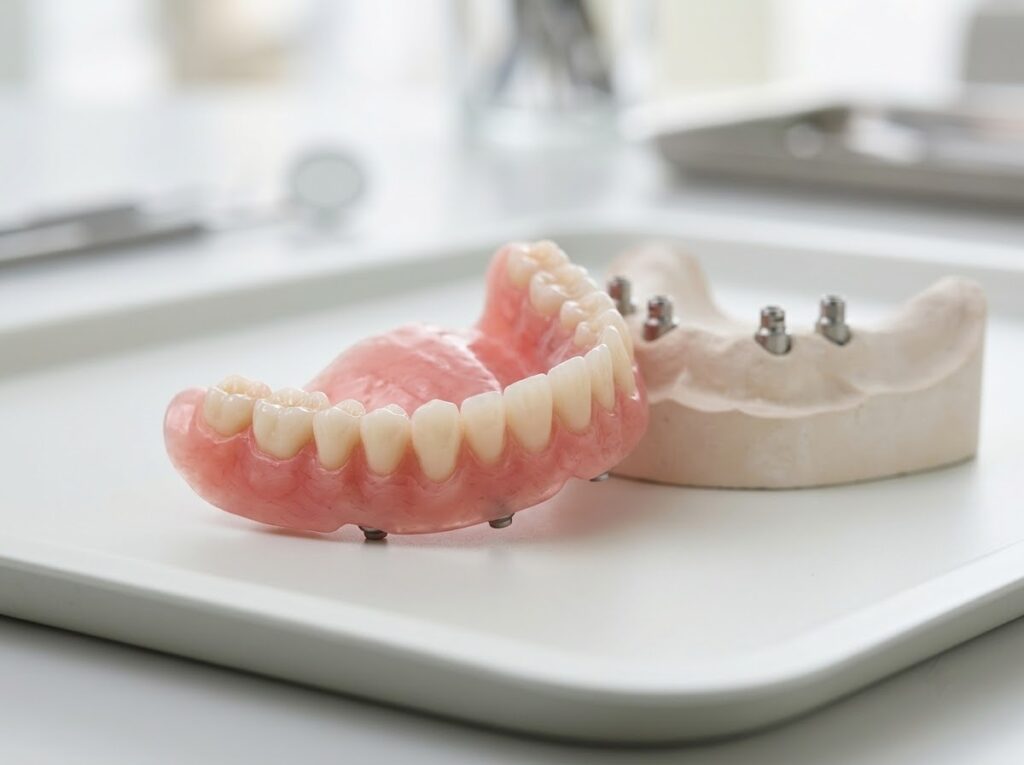
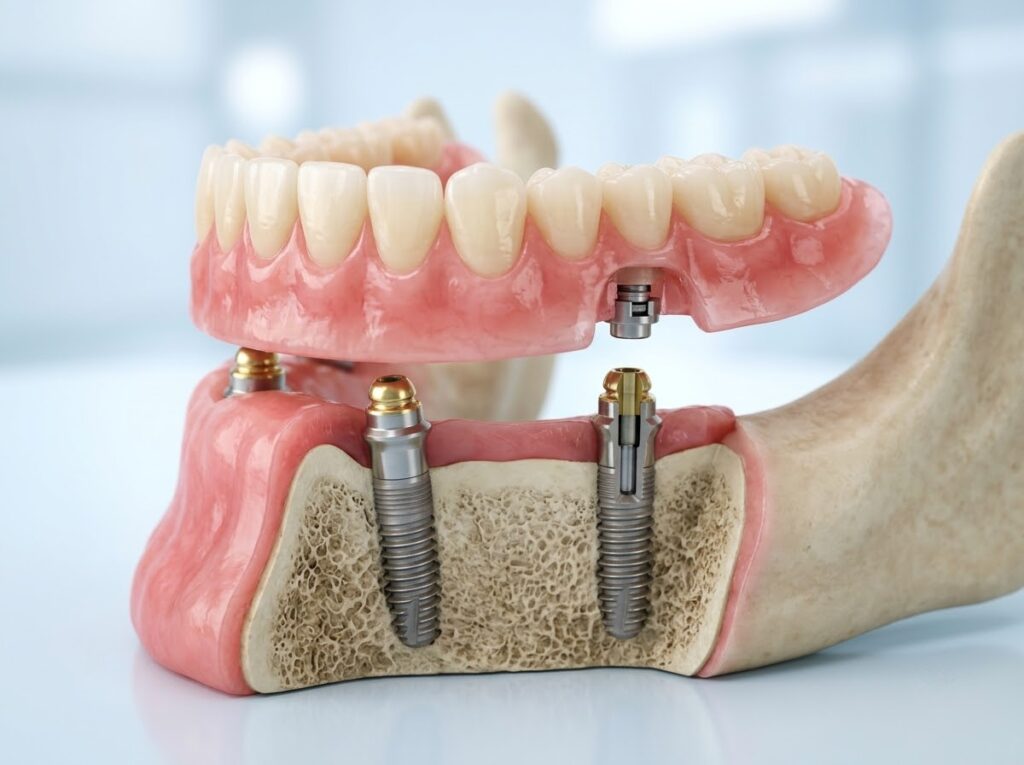
Short answer: An implant-supported denture, also called an overdenture or snap-on denture, is a removable full denture that clips on to two or more dental implants. The implants hold it steady during eating and speaking. You remove it yourself for cleaning and, usually, at night.
| Topic | Summary |
|---|---|
| What it is | A removable complete denture secured by implants |
| Other names | Overdenture, implant-retained denture, snap-on or snap-in denture |
| Implants needed | Commonly two to four in the lower jaw; usually four or more in the upper jaw |
| How it attaches | Stud (press-button) attachments, ball attachments, or a bar with clips |
| Removable by patient? | Yes |
| Best suited to | People without teeth who struggle with conventional dentures, especially lower ones |
| Procedure | Minor surgery under local anaesthesia, usually day-care |
| Ongoing care | Daily cleaning; periodic replacement of retention inserts; occasional relining |
A conventional complete denture stays in place through a combination of close fit, a thin film of saliva and the control of your tongue and cheek muscles. In the upper jaw, the broad palate provides reasonable suction. In the lower jaw, there is only a narrow horseshoe of ridge, with the tongue on one side and the cheeks on the other continually dislodging the plate.
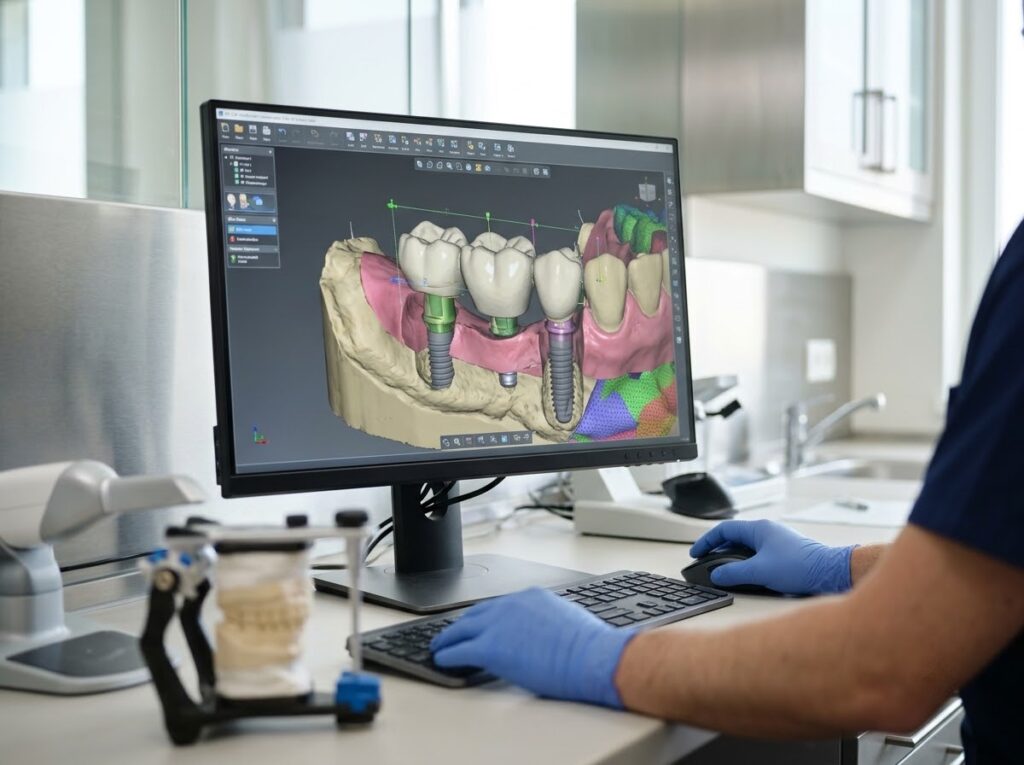
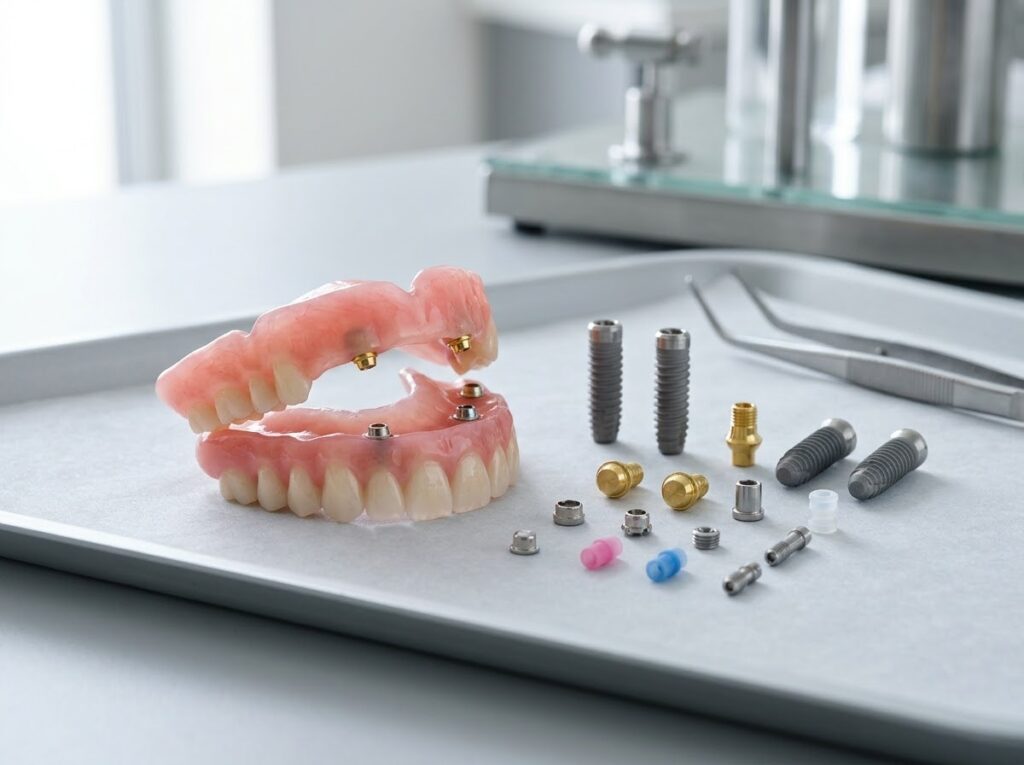
An implant-supported denture adds a mechanical anchor. Small titanium implants are placed in the jawbone and, once they have bonded, special connectors are attached to them. Matching housings are built into the fitting surface of the denture. When you seat the denture, the two halves engage – rather like a press-stud on clothing – and the denture is held firmly until you choose to unclip it.
The denture itself is still made of acrylic with artificial teeth and pink gum-coloured base. What changes is its behaviour: it no longer relies on suction, paste or muscular juggling to stay put.
These terms are often used interchangeably in everyday speech, but they describe slightly different designs.
Both are removable, and both are a considerable step up in stability from a plate with no implants. Your dentist will explain which category your proposed design falls into.
People seldom ask for an “overdenture” by name. They describe a difficulty, and this treatment happens to be the answer. Typical complaints include:
When the underlying ridge has resorbed, even a skilfully made conventional denture has little to grip. Implants provide the anchorage the ridge can no longer offer.
Once teeth are removed, the bone that surrounded their roots loses its purpose and gradually resorbs. The change is fastest in the first year and continues at a slower pace for life. The lower jaw generally loses height more quickly than the upper. As the ridge flattens, muscle attachments that used to lie well below the denture border come to sit level with it and lift the plate with every movement.
Other contributors are weight loss, reduced saliva due to age or medicines, worn denture teeth that alter the bite, and a denture that has simply not been relined for many years. Part of the assessment is to work out which of these factors apply to you, since some can be corrected without implants.
Implant-supported dentures are most often recommended for:
Age by itself is not a barrier; many overdenture patients are in their seventies and eighties. What matters is fitness for a minor surgical procedure and the ability to insert, remove and clean the denture.
| Attachment Type | Hold | Space Needed | Cleaning | Servicing |
|---|---|---|---|---|
| Stud (locator-type) | Adjustable, good | Least | Easy – individual studs | Nylon inserts replaced periodically |
| Ball | Good | Moderate | Easy | Rings or caps replaced periodically |
| Bar and clip | Very firm | Most | More demanding under the bar | Clips replaced or tightened as needed |
| Magnet | Gentle | Moderate | Easy | Magnets may weaken over time |
Each implant carries a low-profile stud. The denture contains metal caps with replaceable nylon inserts that snap over the studs. Inserts are available in different grip strengths, so the hold can be tuned to what your hands can manage. This is the most widely used system because it is compact, easy to clean and simple to service.
The implant abutment ends in a small ball, and the denture holds a socket with a rubber ring or spring that grips it. It works on the same principle as the stud system and has been in use for a long time. It needs slightly more vertical space inside the denture.
A slim metal bar is screwed across two or more implants, following the curve of the jaw. Clips inside the denture fasten on to the bar. Joining the implants together spreads forces and gives very firm support, which is useful in the softer bone of the upper jaw. Bars need more room, cost more to make and require careful cleaning underneath.
Magnetic attachments and precision telescopic crowns are used less commonly, usually for specific situations such as patients who cannot manage a snap-fit.
Narrow-diameter implants may be considered when the ridge is too thin for standard implants and grafting is not desired. They can sometimes be placed with a simpler procedure. Their suitability and long-term behaviour depend on bone quality and the number used, so they are selected with care.
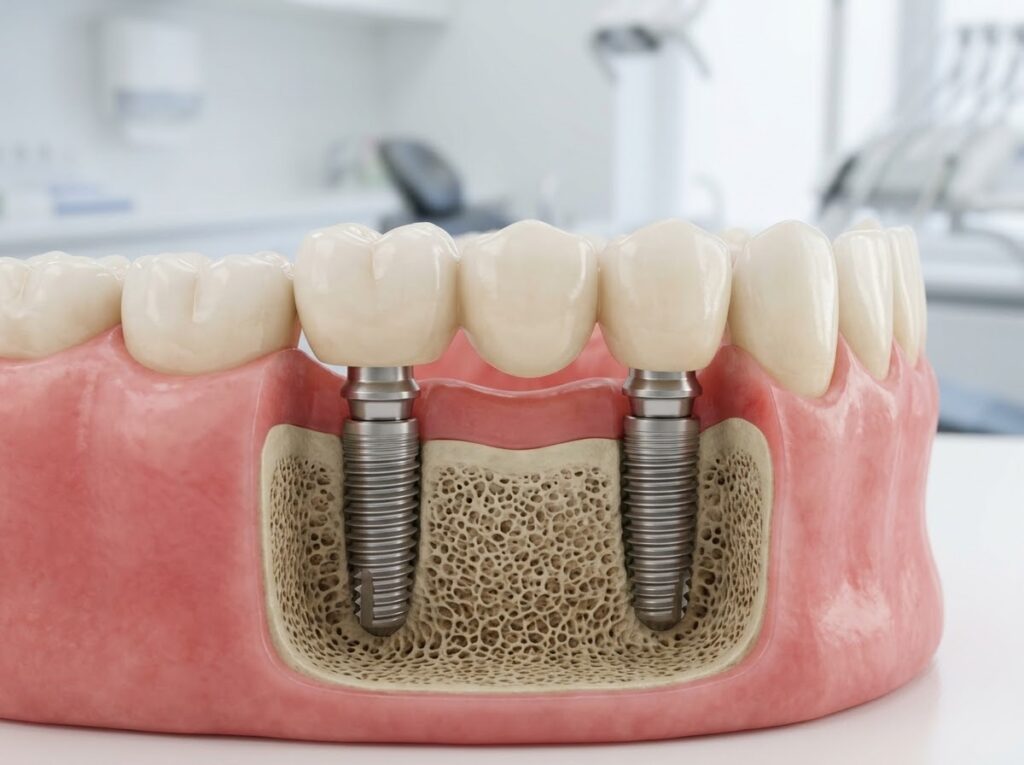
Two implants placed towards the front of the lower jaw are widely regarded in dental literature as an effective minimum for stabilising a lower denture. The bone here is usually dense and clear of the main nerve. Some patients are advised to have three or four implants, for example where the ridge is very flat, the bite is heavy or a bar is planned.
Upper bone is softer, so two implants are generally not considered enough. Four implants, well spread and sometimes joined by a bar, are the usual recommendation. With adequate implant support, the central part of the palate may be left uncovered, which many people find more comfortable.
The number is settled after considering bone volume and density on the scan, the shape of the jaw, what the denture bites against, and your budget. More implants give more support and a degree of security should one fail, but also increase cost and surgical time.
| Option | Stability | Surgery | Removable | Relative Cost | Typical Role |
|---|---|---|---|---|---|
| New conventional denture or reline | Limited, especially lower | None | Yes | Lowest | First step when the existing denture is simply old or ill-fitting |
| Denture adhesive | Temporary | None | Yes | Ongoing small expense | Short-term aid |
| Two-implant lower overdenture | Good | Minor | Yes | Moderate | Common solution for a loose lower denture |
| Four-implant or bar overdenture | Very good | Moderate | Yes | Higher | Upper jaw, heavy bite, flat ridges |
| Fixed full-arch implant teeth | Highest | More extensive | No | Highest | Those wanting non-removable teeth with adequate bone |
A fair consultation will start with the simplest measure that can solve your problem and move up only as far as is needed.
The dentist begins by asking exactly what troubles you: looseness, pain, appearance, chewing or speech. The answers shape the design.
Your current dentures are checked for fit, tooth wear, bite and base extension. A well-fitting denture can sometimes be reused; a poor one will need replacing regardless of implants.
The ridges, gum thickness, muscle attachments, saliva, tongue size and any sore or infected areas are assessed. Fungal infection beneath a denture, which shows as a red palate, is treated before surgery.
Diabetes control, heart and kidney conditions, blood-thinning medicines, bone medicines and tobacco habits are reviewed. A physician’s note may be requested for elderly patients or those with several conditions.
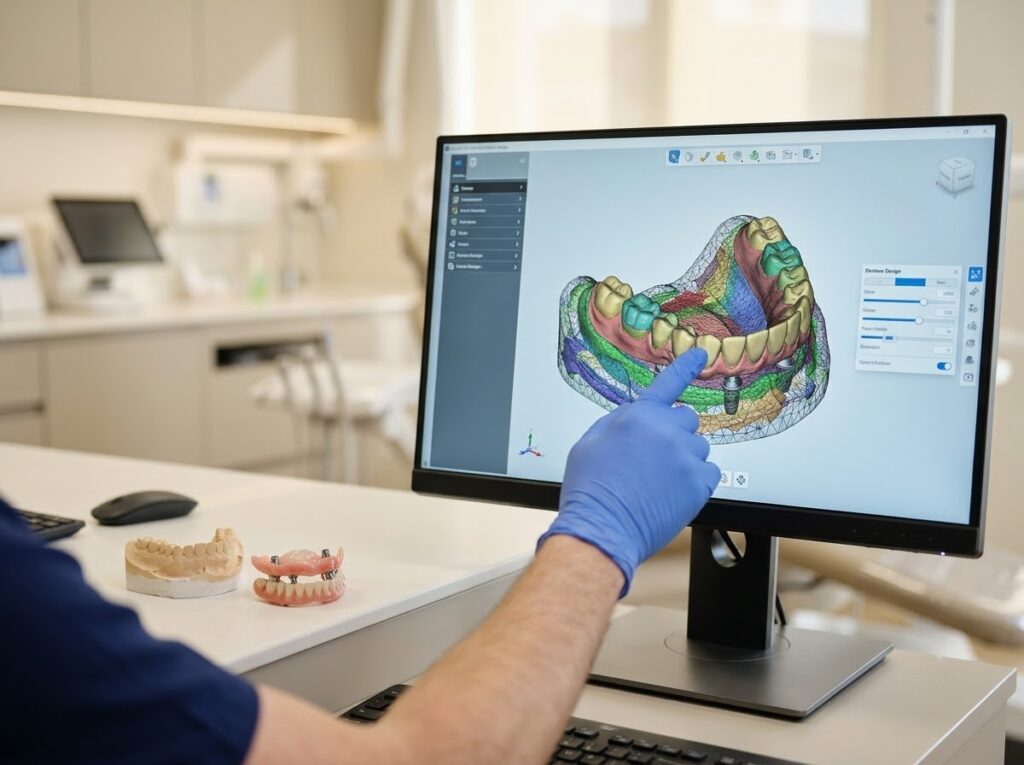
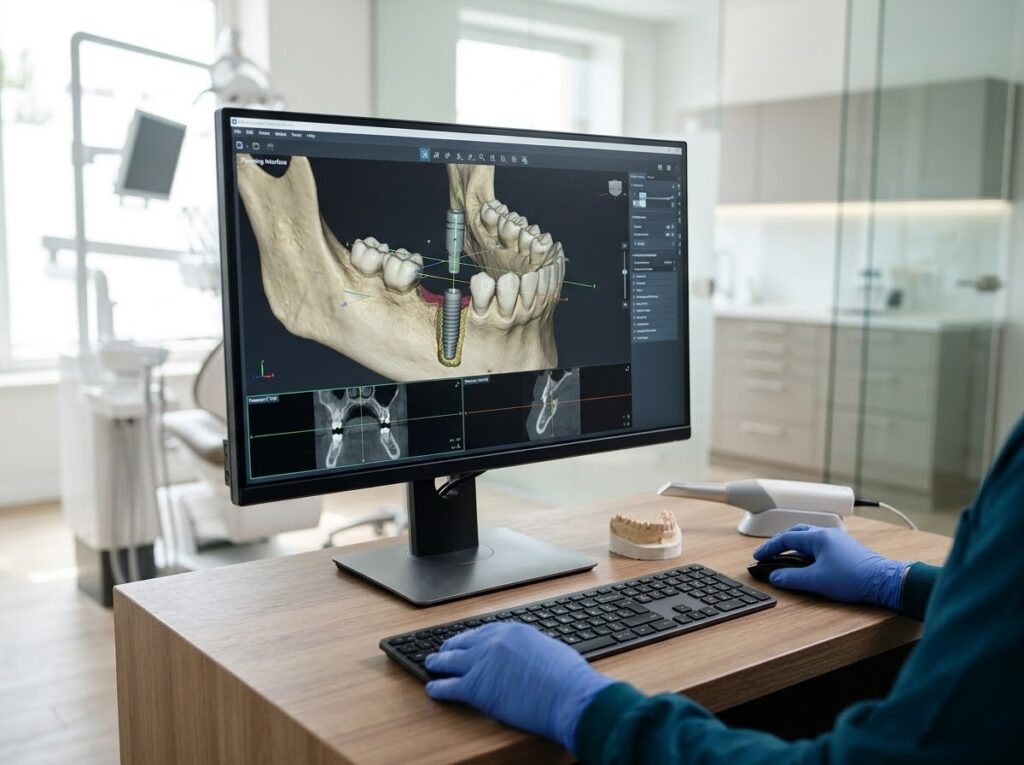
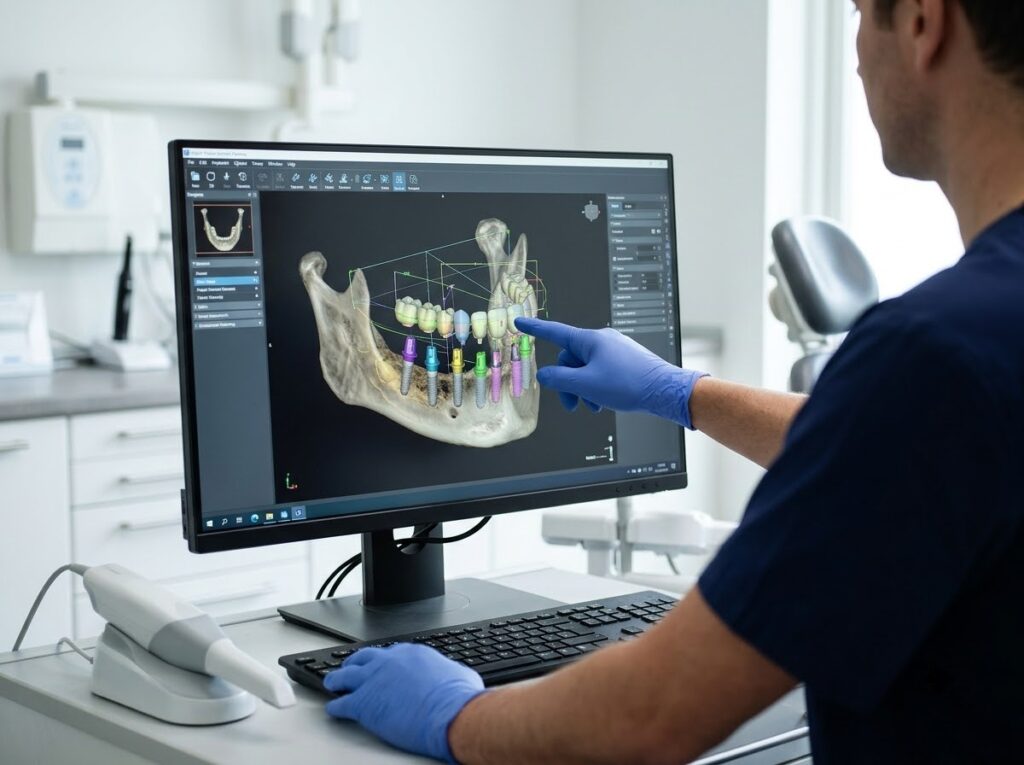
A panoramic X-ray gives an overview, and a CBCT scan measures bone height and width at the proposed implant sites and shows the position of the nerve exits in the lower jaw.
Attachments and denture teeth need a certain amount of vertical room. If the jaws are close together, the choice of attachment may be limited or some bone recontouring may be planned.
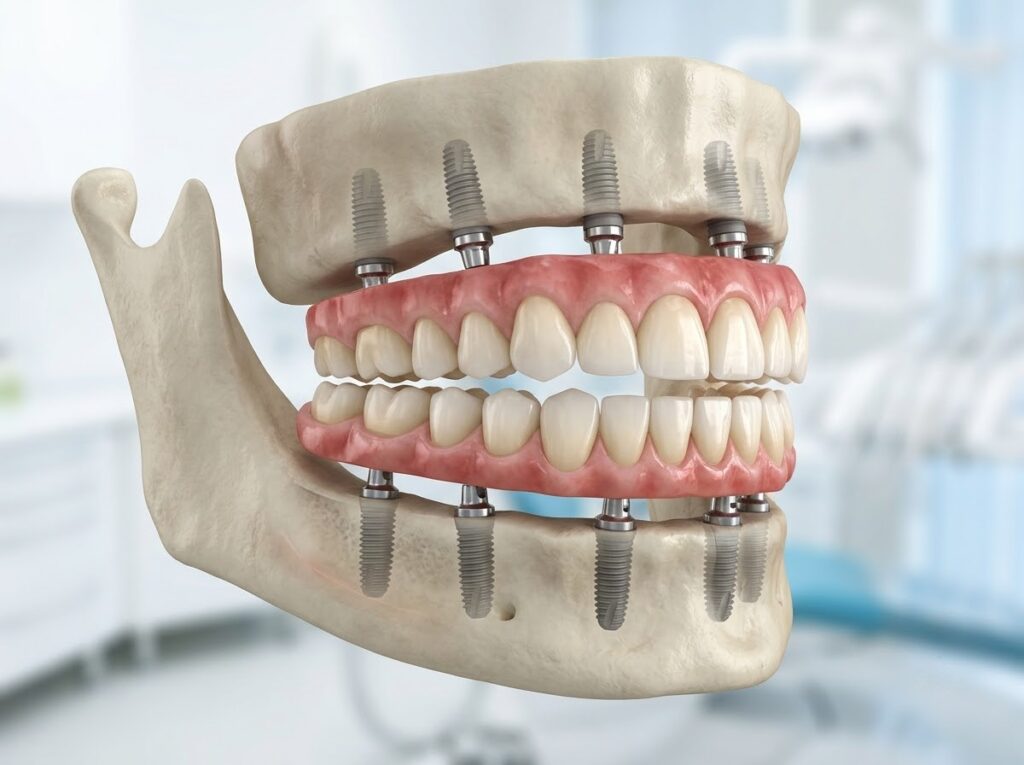
Every stage is planned around your scans, your bone and the final teeth you need.
Records are taken, and a decision is made either to construct a new denture or to adapt the present one. Where a new one is needed, it is often made first, because its tooth position guides where the implants should go.
Under local anaesthesia, small openings are made in the gum, the bone is prepared and the implants are inserted. In a two-implant lower case this is a comparatively brief procedure. Stitches are placed where needed.
The fitting surface of the denture is hollowed over the implants and lined with a soft cushion material so that it can be worn without pressing on them. You are usually asked to leave the denture out for a short initial period, as advised.
Bone bonds to the implants over approximately three to four months in the lower jaw and often somewhat longer in the upper.
The implants are uncovered if necessary. Studs, balls or a bar are fixed on to them. The matching housings are then incorporated into the denture, either directly in the mouth or by the laboratory.
You practise seating and removing the denture in front of a mirror until you can do so confidently. Cleaning of both the denture and the attachments is demonstrated.
The bite, comfort and retention are checked after a few days and again after a few weeks. Sore spots are eased and insert strength is adjusted if the denture feels too tight or too slack.
Sometimes. If your present denture fits the ridge well, has teeth that are not badly worn, sits in the correct bite and has enough thickness to house the attachments, it may be possible to modify it. This saves the cost of a new denture. If it is old, cracked, heavily relined or has an incorrect bite, building a new one gives a better and longer-lasting result. The dentist will give you a frank opinion after inspecting it.
In selected lower-jaw cases where the implants achieve strong initial stability, attachments may be connected early. More commonly, a period of undisturbed healing is preferred before the denture is clipped on, because movement during bonding can jeopardise the implants. Whichever protocol is followed, you will not normally be left without a denture for more than the short initial rest period.
The surgery is carried out with local anaesthesia and is generally well tolerated, including by older adults. The injection numbs the area completely; you may notice pressure but should not feel sharpness. Sedation can be discussed for anxious patients. Mild swelling and tenderness for a few days afterwards are expected.
Why patients choose implant treatment over removable options.
Greatly reduced lifting, tipping and sliding.
Many people return to foods they had abandoned.
Pastes and powders are usually no longer needed.
Less movement means less rubbing.
The plate does not shift mid-sentence.
The denture is cleaned outside the mouth and the attachments are easy to reach.
Fewer implants and a less complex prosthesis.
Loading helps maintain bone in that region.
The denture base replaces lost gum and bone contour.
Particularly for the two-implant lower design.
The appointment is a day-care visit; you go home afterwards. After the implants are placed and the gum is sutured, you receive instructions on diet, medicines and when to begin wearing the adjusted denture. Ask for the instructions in writing, and make sure a family member hears them too.
| Time | What to Expect |
|---|---|
| First day | Minor oozing, numbness wearing off; rest; cool soft diet |
| Two to four days | Some swelling and tenderness; medicines as prescribed |
| About one week | Stitch review; denture relieved and soft-lined for wear |
| Following three to six months | Implants bond; soft lining refreshed as needed; routine life continues |
| Attachment visit | Studs or bar connected; denture now clips on |
| First month of use | Minor adjustments; getting used to inserting and removing |

Position the denture over the attachments, feel it locate, then press down evenly on both sides with your fingers until it clicks. Do not bite it into place; biting can damage the inserts and housings.
Place your thumbs or fingertips under the edge of the denture on both sides and lift evenly. Avoid levering from one side only.
Remove it after meals where practical and rinse. Once a day, brush every surface, including inside the housings, with a soft denture brush and mild soap or a non-abrasive denture cleanser. Ordinary toothpaste is too abrasive for acrylic. Clean it over a basin of water or a folded towel so that it does not break if dropped.
Brush the studs, balls or bar and the gum around them twice daily with a soft toothbrush. Use a small interdental brush or floss beneath a bar. Massage and brush the rest of the gum ridge and the tongue as well.
Unless told otherwise, leave the denture out while sleeping and store it in clean water. This lets the gums recover and lowers the risk of fungal infection.
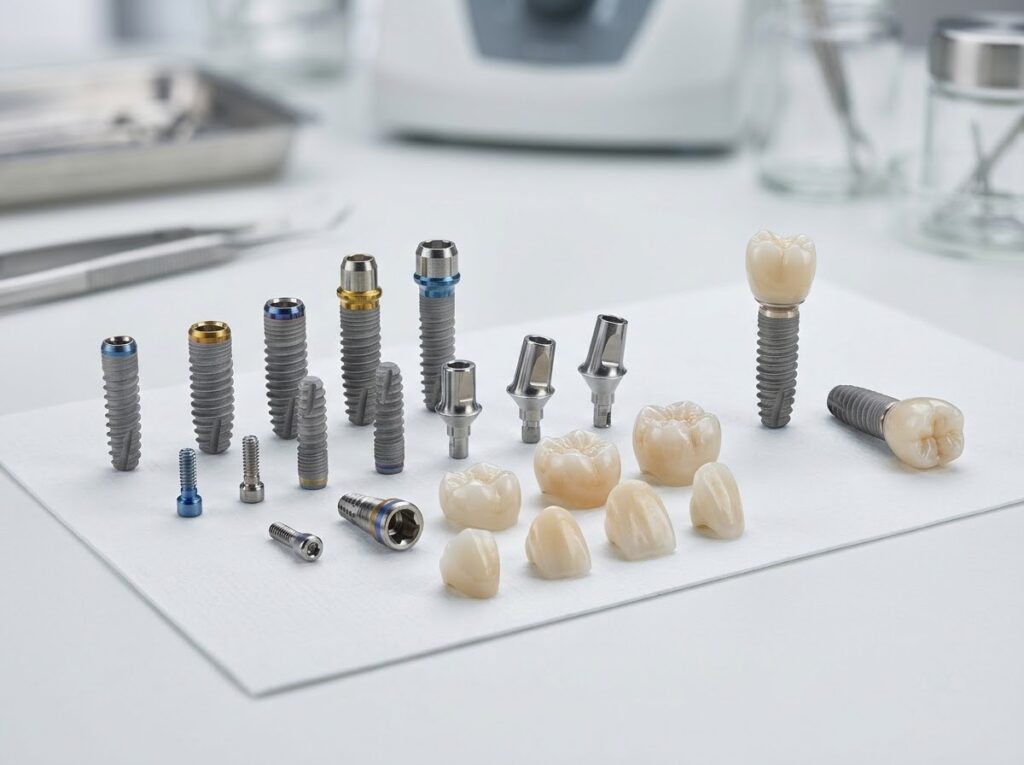
An implant denture is a mechanical appliance, and like any such device it requires servicing.
A review once or twice a year is generally advised, even when everything feels satisfactory.
Most patients resume light daily activities the day after surgery. Avoid strenuous effort for a few days. Speech and chewing with the clipped-in denture usually feel natural within a couple of weeks, and many people notice the improvement in stability from the very first day the attachments are engaged.
A large share of overdenture patients are senior citizens, and planning for them involves more than counting implants.
Older adults frequently take several medicines – for blood pressure, the heart, diabetes, the thyroid or joint pain. Some thin the blood, some dry the mouth and some affect bone healing. A complete, written medicine list, ideally brought in by a family member, prevents oversights. Appointments are kept short and scheduled at a time of day when the patient feels strongest, often mid-morning after breakfast and regular medicines.
Arthritis, tremor or the after-effects of a stroke can make a tight snap-fit difficult to operate. Attachment strength can be reduced, or a design chosen that needs less force. It is sensible to test this at the fitting visit rather than discover the problem at home.
Where memory is failing, a simple daily routine helps: denture out and brushed at the same time each evening, kept in a labelled container in a fixed place. Marking the denture with the patient’s name is worthwhile for anyone who may spend time in hospital or a care facility.
A spouse, son, daughter or attendant should attend the instruction visit and learn how to remove, clean and reseat the denture and how to brush around the attachments. If the patient later becomes unable to manage alone, care continues without interruption.
Better chewing ability makes it easier to include vegetables, fruit, pulses and other protein sources in the diet. Families often notice that an elderly relative who had drifted into a diet of tea, biscuits and soft rice begins eating more varied meals once the denture is steady. Dietary change should be gradual, and advice from the treating physician or a dietitian is helpful for those with diabetes or kidney disease.
A standard upper complete denture covers the entire roof of the mouth, because that broad surface is what creates suction. Some people adapt to this easily; others dislike the bulk, feel nauseated or miss the sensation of food and temperature on the palate.
With sufficient implant support – typically four well-distributed implants, sometimes linked by a bar – the denture no longer depends on suction, and the central palatal portion can often be cut back to a horseshoe shape. This is a meaningful comfort gain for those who gag. It is not automatic, though. If only a few implants can be placed or the bone is soft, keeping full palatal coverage shares the load with the tissues and protects the implants. The dentist will indicate which is appropriate once the scan has been studied.
Sinus position also affects upper cases. Implants are generally placed in the front and premolar regions where bone is deeper, avoiding the need for sinus surgery in many patients.
The opposing jaw has a strong influence on how an overdenture behaves.
This is why two patients with apparently identical lower jaws may receive different recommendations.
| What You Notice | Likely Reason | What to Do |
|---|---|---|
| Denture has become easy to dislodge | Worn retention inserts | Book a visit for replacement inserts |
| Denture will not seat or needs force | Debris in a housing, bent clip or damaged insert | Clean the housings; do not bite it down; have it checked |
| Rocking at the back when chewing | Ridge has changed; reline due | Arrange a reline assessment |
| Sore area under the base | Pressure spot or trapped food | Remove, rinse, rest the area; see the dentist if it persists beyond a few days |
| Red or bleeding gum around a stud or bar | Plaque build-up | Improve brushing there; request professional cleaning |
| Clicking or a loose-feeling stud | Abutment has loosened | Stop wearing if possible and attend promptly for tightening |
| Crack in the pink base | Drop or fatigue over a housing | Do not glue it yourself; bring it in for laboratory repair |
| Bad odour despite cleaning | Deposits inside housings or fungal growth | Professional cleaning and review of night-time wear |
Home repairs with household adhesives should be avoided, as they distort the fit and can make proper repair impossible.
“With implants, the denture becomes permanent.” An overdenture remains a removable appliance. Fixed teeth are a different treatment.
“After implants the denture needs no further attention.” Inserts wear and ridges change. Servicing is part of the arrangement.
“Implant surgery is too risky for elderly people.” With medical evaluation and a conservative plan, many older adults undergo the two-implant procedure safely.
“Mini implants and standard implants are the same thing.” They differ in diameter, indications and load-bearing capacity; the choice is made case by case.
“A tighter click is always better.” Excessive retention makes removal difficult and wears components faster. The right grip is one you can operate comfortably.
The fee is influenced by:
When budgeting, remember to account for periodic servicing. Ask what each maintenance item costs and how frequently it is typically needed.
Implant treatment and dentures are usually outside the scope of standard health insurance in India, though individual policies vary. Please confirm with your insurer.
Meet your implantologist
Managing Director
Dental Surgeon & Implantologist
Dr. Ashish Jain is the founder and Managing Director of Smile Dental Clinic, Indore, practising as a dental surgeon and implantologist.
For overdenture patients, many of whom are older and have other health conditions, careful medical review, conservative surgery and patient instruction are as important as the implants themselves. The clinic’s approach is to select the simplest design that reliably solves the patient’s problem.
Vikas Singh Gurjar
My experience was very good … very well taken care of .Thank u Dr Anjaly , Dr Vatsal, Deepak , Ganesh , Vishnu and Gopal for your services.
View on Google Shrutikirti Bhatele
My experience was the best dental experience ever. The doctors are polite and they explain you every single detail. I am so satisfied that I chose to come here. Thank you Smile Dental Clinic.
View on Google Sarita Patel
I am relationship satisfied with the treatment doctors are so helpful and kind
View on Google nivi jain
The treatment was amazing I got done scaling and the doctors were very helpful.
View on Google Dheeraj Patidar
I had a great experience at Smile Dental Clinic with my orthodontic treatment. I was suffering from a crossbite, which made it difficult for me to eat comfortably. After completing my treatment, the problem has been resolved, and my smile has improved significantly. I am extremely happy with the results! The Dr Satyajit Tekade is very skilled, friendly, and supportive, and the other doctors at the clinic were also very kind and professional. The entire experience was smooth and comfortable, and I truly appreciate the care and guidance I received throughout my treatment. I am highly satisfied with my treatment and would definitely recommend this clinic to anyone looking for quality dental care!
View on Google Kavya
𝕋𝕙𝕖 𝕤𝕥𝕒𝕗𝕗 𝕞𝕖𝕞𝕓𝕖𝕣𝕤 𝕒𝕟𝕕 𝕕𝕠𝕔𝕥𝕠𝕣𝕤 𝕒𝕣𝕖 𝕖𝕩𝕔𝕖𝕝𝕝𝕖𝕟𝕥... ❤️💖😁😁
View on GoogleClear answers to what patients ask us most. Still unsure? Our team is happy to talk it through.
Call us or book a visit and we will answer your questions in person.
They are removable by you. They clip firmly on to the implants during the day and are taken out for cleaning and at night. If you want teeth that never come out, ask about fixed full-arch implant options.
For many people, yes. Two implants at the front of the lower jaw are a well-established way to stabilise a lower denture. Additional implants are suggested when the ridge is very flat or more support is wanted.
Bone in the upper jaw is less dense, and the forces on an upper denture tend to tip implants. Spreading the load over four or more implants improves reliability.
Allow a few months from implant placement to final attachment, mainly for bone healing. You continue to wear a denture for most of this time.
The procedure is performed under local anaesthesia. Afterwards, discomfort is usually mild to moderate and settles within several days with the prescribed medicines.
It varies with how often the denture is removed and how you bite. Many people need new inserts every one to two years. It is a brief visit.
It is generally better to remove it at night. Resting the gums reduces soreness and infection risk. Follow the specific advice given to you.
Chewing is considerably better than with a loose denture, and most everyday foods can be managed. Very hard or sticky items should still be approached carefully, particularly with a two-implant design.
In some cases additional implants can be placed and the treatment upgraded to a fixed prosthesis. Mention this possibility at the planning stage so that implant positions can be chosen with it in mind.
Many patients in this age group undergo the procedure after medical evaluation. The two-implant lower design involves relatively minor surgery.
It is removed, and after healing a replacement may be placed in the same or a nearby site. Meanwhile the denture can usually be worn with a soft lining.
You do not have to accept a denture that moves. Bring your current dentures to Smile Dental Clinic for an assessment. You will be told plainly whether a reline, a new denture or implant attachment is the most sensible route, with an explanation of the steps, time and cost involved.
This page is intended for general information. Individual advice requires a clinical examination. Results and maintenance needs vary.