

Home » Treatments » Root Canal Treatment in Indore
A root canal or endodontic treatment is the procedure that involves the removal of the dental pulp tissue from the root (canal) system of a tooth.
A tooth may have multiple roots and these roots contain one or more canals. If an infectious or noxious agent reaches the pulp; it may get infected or inflamed (or both). This condition warrants treatment and involves the removal of the infected pulp tissue. As soon as the infected pulp is removed from the root’s canal, it is cleaned thoroughly, disinfected and re-shaped to accept a filling material and finally it is filled with a permanent filling.
At Smile Dental Clinic; we specialize in root canal procedures as this has been a part of our routine practice since over 17 years. In these years we have gone from traditional root canal therapy to a high-tech and modern endodontic treatment practice with the use of operating microscopes, CBCT, 3D obturation armamentarium and so on. Our focus during root canal treatments is to ensure that the patient gets relief from acute pain, have minimum number of visits and ensure that the tooth is restored to its natural form and function.
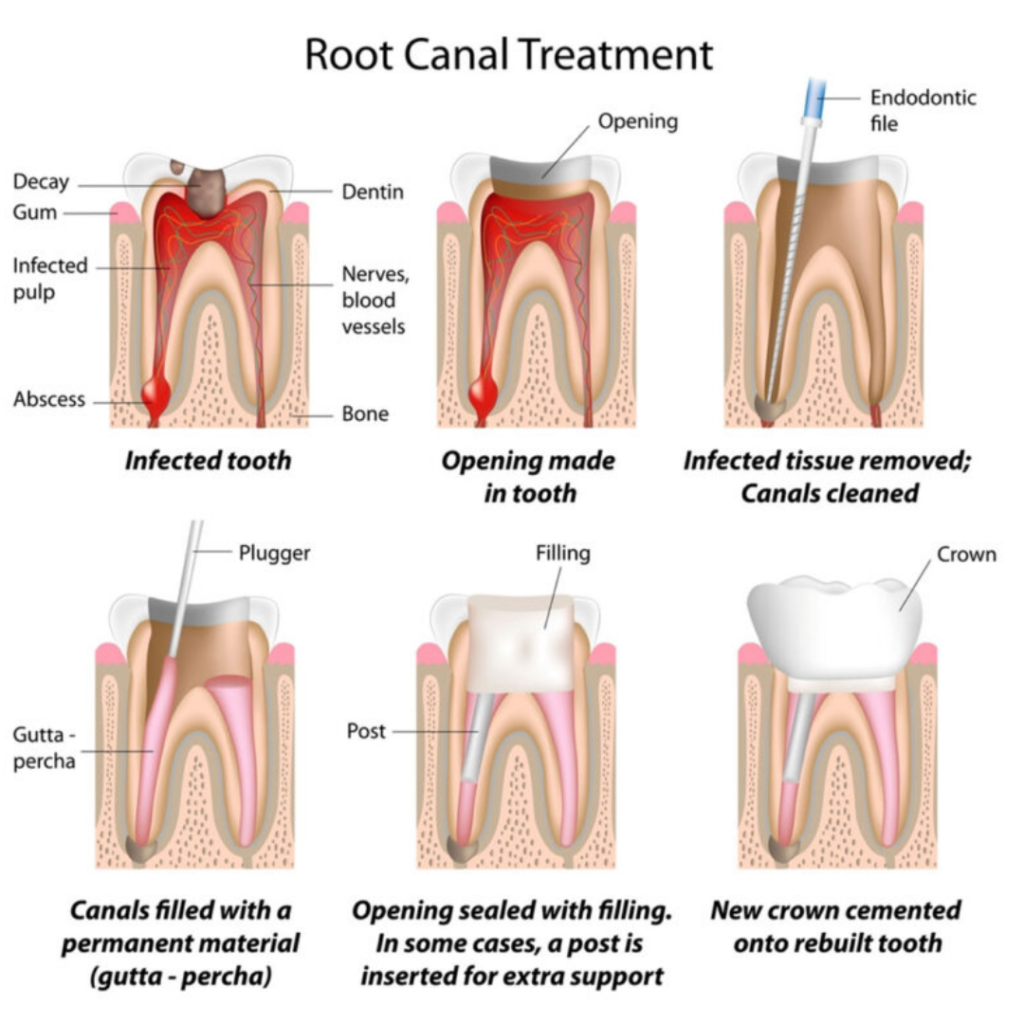
Root canal treatment (RCT) removes infected pulp from inside a tooth, disinfects the canals and seals them, saving a tooth that would otherwise need extraction. Smile Dental Clinic Indore offers single-sitting, painless RCT using in-house CBCT and modern endodontic techniques for precise and accurate results.
Root canal treatment, also called endodontic treatment, is the removal of infected or inflamed pulp tissue from the inner canals of a tooth. The pulp contains nerves and blood vessels, and when decay or injury reaches it, the result is pain, sensitivity and infection.
During the procedure, the dentist cleans and shapes the canal system, disinfects it, and fills it with a sealing material. The tooth is then restored with a filling of the damaged tooth structure and crown so it can function normally for years.
Saving a tooth with RCT offers clear advantages over removing it:
A typical root canal at our clinic follows these steps:
✅ Detects hidden canals and cracks
✅ Identifies the exact size and location of infection
✅ Improves treatment success rates
✅ No need to visit another center for scanning
✅ Faster treatment planning and convenience
Root canal versus extraction/removal for an infected tooth:
Factor | Root Canal Treatment | Tooth Extraction |
Keeps natural tooth | Yes | No |
Bone preservation | Yes | Bone resorbs over time |
Follow-up needed | Crown for protection | Implant/bridge to fill gap |
Effect on chewing | Restored | Reduced until replaced |
RCT is recommended when decay or injury has reached the pulp, when there is a dental abscess, or when a tooth is sensitive to heat and lingering pain. Cost varies with the tooth involved, the complexity of the canal anatomy, whether retreatment is needed and the final restoration chosen.
Smile Dental Clinic Indore performs single-sitting and painless root canals using modern endodontic methods, including microscopic and 3D obturation techniques with high quality materials described on the clinic’s services. Treatment is carried out by an experienced clinical team that has practised digital, single-sitting dentistry in Indore since 2006.
Tooth pain or sensitivity should not be ignored. Book a root canal consultation at Smile Dental Clinic Indore by calling +91-9826092665 and save your natural tooth.
Modern root canals are done under local anaesthesia and are usually no more uncomfortable than a routine filling. Single-sitting techniques further reduce treatment time.
Many cases are completed in a single sitting. More complex or heavily infected teeth may need an additional visit.
A crown is often recommended, especially for back teeth, because a treated tooth can become brittle and benefits from added protection.
Untreated pulp infection can spread, cause an abscess, and may eventually lead to tooth loss, so early treatment is best.
RCT usually takes 30–90 minutes per visit, depending on the complexity of the tooth.
A properly treated and restored tooth can last 15–25 years or even a lifetime with good oral hygiene.
Modern RCT has a success rate of approximately 85–95%.
No. A properly restored RCT-treated tooth with a crown provides near-normal chewing efficiency.
No. RCT may also be required for deep decay, infection, trauma, abscess, or a non-vital tooth without pain.
Yes, if the crack is restorable and has not extended as a vertical root fracture.
A crown is strongly recommended for premolars and molars to prevent fracture. It may not always be necessary for anterior teeth.
The root canals are filled with gutta-percha along with a root canal sealer.
The choice depends on the tooth and esthetics. Zirconia and porcelain-fused-to-metal (PFM) are commonly used options.
Mild pain or tenderness for a few days is common. Serious complications are uncommon when the procedure is done properly.
The tooth may become more brittle due to loss of tooth structure, which is why a crown is often advised.
Whenever possible, saving your natural tooth with RCT is preferred. Implants are recommended when the tooth cannot be saved.
No. The natural tooth is preserved; only the infected pulp tissue is removed.
No. The pulp is removed, so the tooth is no longer vital, but it remains functional in the mouth.
Mild discomfort may last for a few days, but the pain from infection usually resolves after treatment.
Most patients require medications for 2–5 days, depending on the condition and the dentist's advice.
Avoid chewing on the treated tooth until the final restoration is placed and maintain good oral hygiene.
Avoid hard foods until the permanent crown or restoration is placed to prevent fracture.
Choose soft foods such as rice, yogurt, dal, soups, mashed vegetables, and smoothies for the first few days.
If the tooth is restorable, re-RCT is usually the first treatment option before considering extraction.
Re-RCT has a success rate of approximately 70–85%, depending on the cause of failure
If the tooth can be predictably saved, re-RCT is generally preferred over extraction and implant placement.
It depends on the cause of mobility. If mobility is due to infection and the tooth has good periodontal support, it may be saved.
Yes. RCT is commonly performed in teeth with infection and pus discharge after proper cleaning and drainage.
Most infections heal after successful RCT, but persistent infection may require re-RCT or surgical treatment.
No. RCT does not harm heart health. In fact, treating dental infections helps reduce the spread of infection.
Yes. Well-controlled diabetic patients can safely undergo RCT with appropriate precautions.
Yes. Most heart patients can undergo RCT after medical evaluation and necessary precautions.
It may be completed in one or multiple visits, depending on the infection and complexity of the case.
Both have high success rates. The choice depends on the tooth condition, presence of infection, and clinical judgment of the dentist Here are concise, patient-friendly one-sentence answers for each question: